 TechAppForce
Custom code with AI assistants vs TechAppForce
Code is debt. Build more product, own less boilerplate.
AI made code cheap. It didn’t make code free: your team still reviews, tests, secures and upgrades every line.
What you would otherwise build and own
The problem
Why are we still coding CRUD?
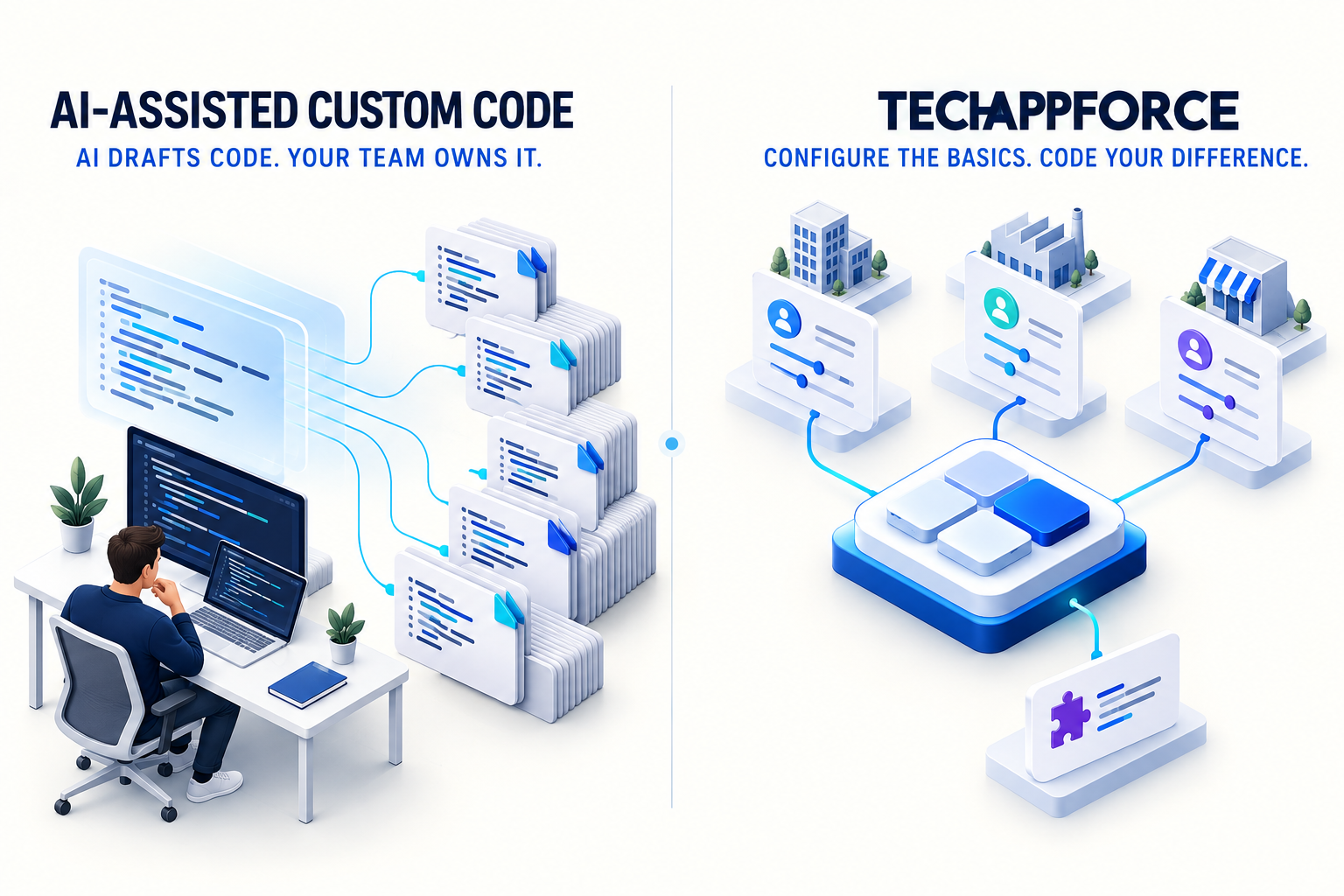
Cursor, Claude Code, Copilot and Codex draft it fast. Your team owns it for as long as the product lives.
How we solve it
The foundations are configuration. Your rules stay code.
Ready on day one, and what makes your product yours stays readable and yours.
Ready on day one
- Records, lookups, files, search and custom fields on a live app
- Lifecycles, multi-level approvals, SLA reminders and a work inbox
- Workflows, background jobs and notifications
- Reports, PDF export, scheduled email and Excel import
- Change history on every record
- Environment diff and release promotion
- Tenants, sign-in and role access at None, Own, Team or All scope
Yours to keep
- Business rules in real C#, plus TypeScript screen extensions
- Custom, versioned API endpoints with an OpenAPI spec
- Bespoke frontends with the Angular or React SDKs
- The whole app in TAF Studio, readable object by object
- Your data in PostgreSQL or SQL Server
Keep your assistants
Use your AI tools on TechAppForce too
Point the assistants your developers like at far less code.
Through the MCP gateway
Claude, Cursor and Codex connect to the same tools.
- Preview
- Confirm
- Applied
Into configuration you can read
Ordinary objects, in a release you diff.
- Objects
- Release diff
For the rules that are yours
C# record hooks and workflow actions.
With TAFI for a guided build
Builds only after you approve each step.
- Requirements
- Blueprint
- Plan
To be fair
When custom AI-assisted code is the right call
AI coding assistants are very good tools. Build it yourself if one of these is true.
Your product is mostly unique logic
An algorithm, a model, a simulation or a real-time engine.
The interface is the product
Games, creative tools, unusual interactive experiences.
The foundation is the product
An approval engine, a reporting tool, an identity service.
You want to own the whole stack
The people, time and reasons to own every layer.
Questions
When AI can already write the code
Claude Code or Cursor could build this in a week. Why use a platform?
They may well build a first version that fast. The question is the years after: reviewing that code, testing it, fixing security issues, upgrading dependencies and changing it for every enterprise customer. On TechAppForce the foundations are configuration the platform maintains, so there is far less code to own.
Who owns the code AI writes for us on TechAppForce?
You do. C# rules, screen extensions and custom API endpoints are your code, in your app, shipped in your releases. There is just far less of it.
We already generated some of this. Do we have to throw it away?
Not necessarily. You can promote an existing database table to a managed entity, call your existing services from workflow actions, and expose what you build through custom API endpoints. The pilot is a good place to decide what moves.
Put your roadmap back on the product
Bring the foundation work you would otherwise prompt, review and maintain. We will show what already exists and what your team would still build.