 TechAppForce
Custom Requests Without Forking: How SaaS Teams Keep One Product
"Can you just add one field for us?" Then: "Can that field only appear for our users?" Then: "Our finance team needs a different approval." Then: "Can we have our own report?" None of these requests sounds large, and that is exactly why they are dangerous.
For a young SaaS company, a customer-specific request feels like a good problem to have. A paying customer wants something, the team can build it, and everyone is happy. The trouble starts when 20 customers ask for 20 different things.
The fork that nobody planned
The quick technical answer is often a branch. Customer A gets the standard product. Customer B gets a branch with an extra field. Customer C gets another branch with a different approval. Six months later, the team is maintaining several versions of the same business logic, and every fix has to be applied in each of them.
The customer request was small. The maintenance model was not.
Decide what should be configuration
A useful SaaS architecture separates two kinds of change.
The first is product logic: what makes your product different. A pricing calculation, a domain-specific rule, an unusual integration. That deserves code.
The second is customer variation:
- a cost-centre field on every order
- finance approval for orders above a threshold
- a spend report every Monday
- a different role that may see a particular record
Those differences do not need another version of the application. They can be settings.
That distinction is the basis of TechAppForce. Entities, fields, screens, queries, lifecycles, approvals, workflows and access rules are configuration, and one application serves every customer with its own settings. Developers extend it with C# record hooks and workflow actions, TypeScript screen extensions or a custom front end when the business needs something genuinely its own.
Configuration only helps if changes are controlled
Configuration on its own just moves the problem. If anyone can change anything directly in the live application, a SaaS team still cannot answer the questions that matter:
- What changed, and who changed it?
- Which customer does it affect?
- Was it tested?
- Will another developer understand it six months from now?
- How does it get to the live environment?
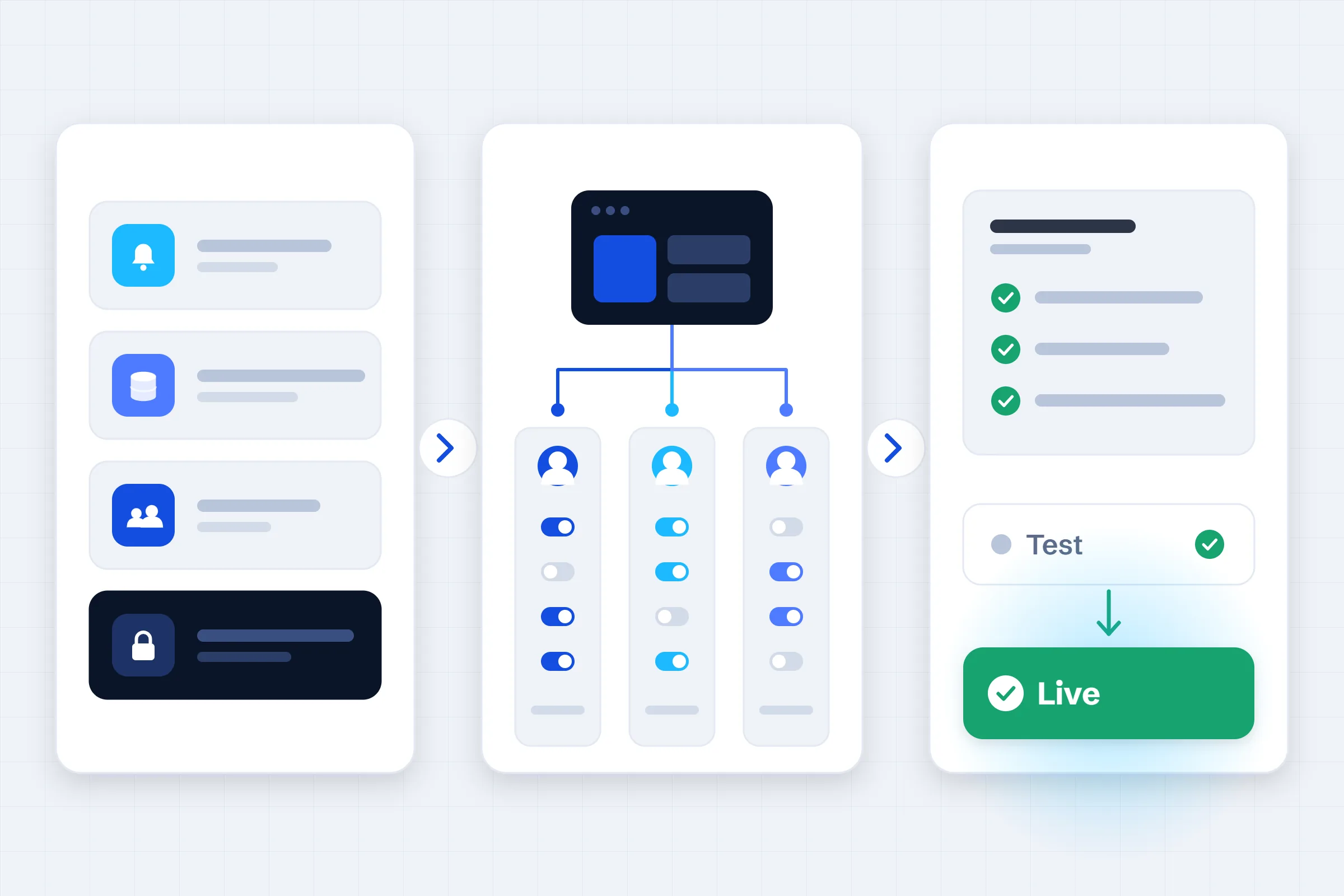
So the architecture has to make change visible. In TechAppForce, every change moves through Development, Test and Live as a reviewed release, and the differences between environments can be compared before anything is promoted. TAF Studio is the workspace for designing, checking and releasing those changes.
That gives a customer request a different path:
- Request
- Configuration
- Review
- Test
- Release
instead of request, branch, custom code, special deployment, and remembering it forever.
Developers still matter
The opposite trap is assuming everything should be configuration. It should not. A proprietary scoring model, an integration with unusual authentication or a screen interaction the standard components cannot express all belong in code. The useful boundary is simple: configure what is common, and code what is genuinely yours.
The goal is not to eliminate code. It is to stop writing the same code for every customer.
AI makes the distinction more important
AI changes the economics of writing code. It does not remove the economics of maintaining it.
In the Stack Overflow 2025 Developer Survey, 84% of developers said they use or plan to use AI tools, and 46% said they do not trust the accuracy of what those tools produce. The most common frustration was AI output that is "almost right, but not quite" (66%), and 45% said debugging AI-generated code takes more time.
Other research points the same way. GitClear's 2025 analysis of 211 million changed lines found refactoring falling from about 25% of changes in 2021 to under 10% in 2024. A 2026 study of 304,362 AI-authored commits found that 22.7% of the issues those commits introduced were still present at the latest version of the code.
The lesson is not "do not use AI". It is simpler: AI made code cheap. It did not make code free. Someone still owns the result.
Put AI inside the release process
TAFI, the TechAppForce AI builder, proposes a plan, previews each change and applies nothing until you approve it. The result is ordinary configuration that goes through the same review and release path as any other change.
That matters for SaaS teams. Ask an AI tool to "add a cost-centre field to every order for this customer" and there are two possible outcomes: the tool changes the application and leaves you to discover what it did, or it shows the change, waits for approval and sends it through review. The second adds a little friction at exactly the right point. The 2024 DORA report estimated a 7.2% drop in delivery stability for every 25% increase in AI adoption, and linked it to larger changes that are harder to review. The answer is not less AI. It is better review around AI.
A real example: Tech Health
Tech Health, a clinical operations portal, moved from sample data to a live TechAppForce backend. Its 81 business entities, about 1,200 fields and 17 lifecycles are configuration, not backend code, and the app's own code shrank by about 17,000 lines (about 10%) while it gained that backend. Its data layer is about a third smaller.
The important part is not the number of lines removed. The team did not write a backend for each entity: the platform handles the common behaviour, and what is specific to Tech Health lives in configuration and in its own interface.
The year-two test
When you evaluate a platform for a SaaS product, do not stop at "how quickly can we build the first version?" Ask what happens when customer number 100 wants its own fields, a different approval threshold, a custom report or a different role structure:
- Can each of those be configuration rather than a branch?
- Can every change be reviewed before it reaches Live?
- Can AI propose changes without applying them on its own?
- Can developers still write real code when configuration is not enough?
- Will the team understand what changed six months later?
These are year-two questions, and year two is the job.
The strongest SaaS architecture is not the one that says yes to every request with more code. It is the one that can say "yes, that's a setting", and when it is not a setting, "yes, that's where our developers write the part that makes your product unique".
Book a demo and bring the customer request you keep saying no to.